
| Key Takeaways: 1. Failed deliveries drain profits through redelivery costs, wasted resources, and lost customers. 2. Electronic POD systems boost customer satisfaction and drastically reduce delivery disputes. 3. Every failed first attempt requires costly redelivery and risks permanent customer loss. 4. Digital POD creates indisputable delivery records that prevent disputes before they start. 5. Structured follow-up processes turn failed deliveries into recovery opportunities rather than lost revenue. |
Here’s the uncomfortable truth about last-mile delivery: somewhere between your warehouse and your customer’s doorstep, things go sideways. Half of online shoppers report delivery problems, and 5-10% of deliveries fail on their first attempt.
The gap between struggling and thriving delivery operations comes down to documentation and follow-up. Modern proof-of-delivery (POD) systems can increase customer satisfaction by up to 30%. This guide shows you how POD systems reduce failed deliveries and what to do when things don’t go according to plan. Let’s go right in!
What is Proof-of-Delivery?
Proof-of-delivery is documented evidence that a package reached its intended recipient. It’s the final confirmation in the delivery chain that protects both businesses and customers from disputes.
Traditional POD meant paper slips with signatures: illegible, easily lost, and not accessible remotely. Modern POD captures multiple data points simultaneously: electronic signatures, timestamped photos, GPS coordinates, and recipient verification.
A complete POD record answers three questions: Was it delivered? When? Who received it? This creates an indisputable record that protects against fraudulent claims while building customer confidence.
Real-Time Tracking vs. Proof of Delivery
Real-time tracking shows where packages are during transit. That’s the “your package is 3 stops away” notification. POD proves packages reached their destination and who received them. Think of tracking as the journey, POD as the destination.
Together, they create seamless transparency. The same GPS powering tracking captures delivery locations for POD. The same driver app handling scanning manages photo capture and signatures.
Customers watch packages approach with accurate ETAs, receive delivery notifications, and immediately view POD documentation. For high-value deliveries or problematic areas, this complete visibility protects everyone involved.
Methods of Proof-of-Delivery
Today’s delivery operations layer multiple verification techniques for bulletproof documentation:
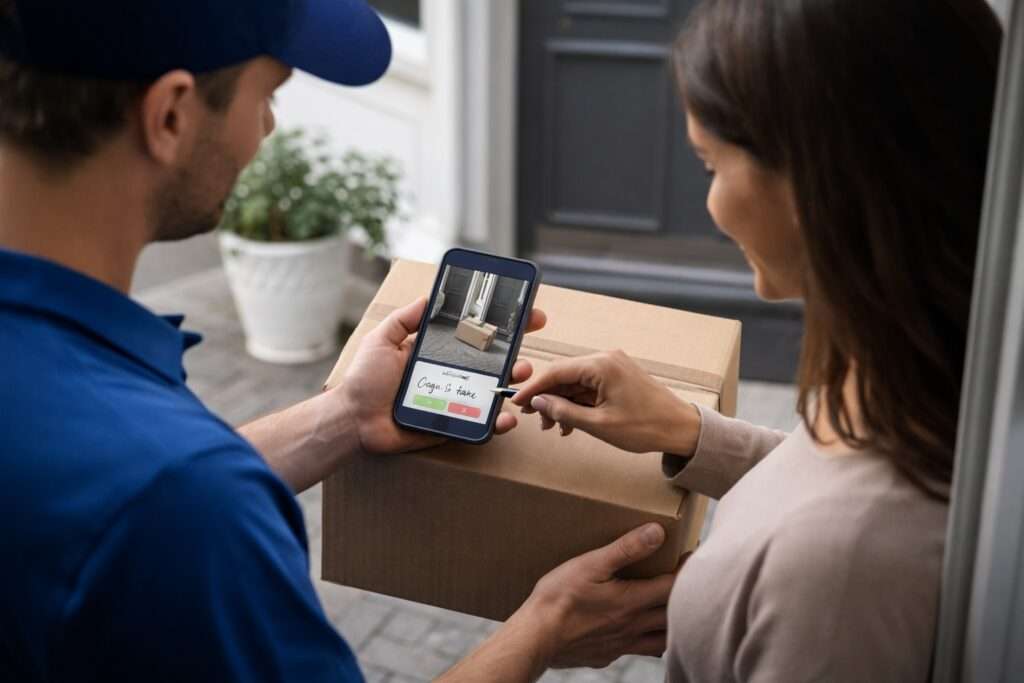
- Digital Signatures: Recipients sign electronically on mobile devices. It’s quick, legally binding, and automatically timestamped with location data.
- Photo Documentation: Drivers photograph packages at delivery locations. This visual proof is invaluable for contactless deliveries and disputed claims.
- GPS Timestamps: Every delivery gets precise coordinates and time stamps, confirming drivers were at the correct address when claimed.
- Barcode/QR Code Scanning: Confirms the right package reached the right location while triggering automatic system updates.
- Recipient Verification: High-value deliveries may require photo ID verification or one-time passcodes sent to recipient phones.
The most robust systems layer multiple methods: signature + photo + GPS + timestamp, all captured in seconds through the driver’s mobile app.
Benefits of a Robust POD System
A robust POD system improves your delivery process in multiple ways:
Dispute Resolution
Digital POD pulls up delivery evidence in seconds, be it signature, photo, GPS data, or timestamp. Quick resolution saves investigation hours and often satisfies frustrated customers with trusted documentation.
Operational Efficiency
Digital systems automate documentation, eliminate paperwork, and reduce administrative overhead. Drivers spend less time on documentation, more on delivering.
Enhanced Customer Satisfaction
Modern consumers expect transparency. Self-service POD portal access shows exactly when and where packages were delivered. It can boost satisfaction as well as customer retention.
Legal Protection
POD records serve as legal evidence in disputes, protecting your business from fraudulent claims with clear records for insurance or legal proceedings.
Cost Savings
Each redelivery costs money, fuel, driver time, vehicle wear, and administration. Robust POD reduces failed deliveries and disputes. At $18 per failed parcel, even small improvements yield significant savings.
Preventing Disputes with Effective POD
Prevention beats resolution. The best POD systems actively prevent disputes:
Set Clear Standards
Establish non-negotiable minimum proof points for every delivery (signature/photo, GPS, timestamp). Make these part of driver training and performance reviews.
Communicate Proactively
Send automated notifications at key milestones, like:
- Out for delivery
- Delivery attempted
- Delivered successfully
Include POD details in confirmations; let customers view delivery photos or signatures in their accounts.
Capture Quality Photos
Train drivers to capture clear photos showing identifiable landmarks, such as house numbers, distinctive doors, recognizable features. Photos should answer: “Where exactly is this package?”
Handle Exceptions Properly
When deliveries fail, document why immediately. Photos of issues (locked gates, no access, wrong address) combined with GPS data create clear records and prevent repeat problems.
Verify Before Delivery
Use address verification tools to catch incorrect or incomplete addresses before dispatch. For high-value items, ask recipients to confirm delivery instructions in advance.
Make POD Accessible
Provide self-service access through customer portals or mobile apps. Customers shouldn’t need to email or call to see their delivery proof.
When customers can see exactly when and where packages were delivered with clear visual evidence, disputes drop dramatically.
Managing Failed Deliveries: Prevention, Response, and Recovery
Speed matters when deliveries fail. Your first-hour response often determines whether you keep or lose a customer.
Immediate Response
Trigger automatic customer notification the moment a delivery fails with clear next steps and resolution timeline. Document failures immediately. Photo evidence plus GPS creates clear records and prevents repeat issues.
Follow-Up Workflow
- Failed attempt → immediate notification with reason and redelivery schedule
- Provide action link for customers to update instructions or select pickup
- After two failures → proactive outreach asking how to complete delivery
Offer solutions, not excuses: rescheduled delivery, pickup locations, or authorized neighbor release.
Prevention Strategies
Following strategies help you prevent failed deliveries and improve customer experience.
- Route Optimization: AI-powered routing considers traffic and time windows so drivers arrive when customers are available.
- Address Validation: Verify addresses at checkout to catch errors before dispatch.
- Flexible Windows: Offer 2-hour slots or let customers choose preferred times.
- Equip Drivers: Provide phone numbers, instructions, and direct contact ability so drivers can confirm availability before arriving.
Using POD Data for Continuous Improvement
POD data isn’t just for disputes, it’s intelligence for operational optimization.
Key Metrics to Track
- First-attempt delivery rate: Industry average is 90-95%; below 90% indicates systemic issues
- POD completion rate: Are drivers consistently capturing complete records?
- Dispute rate: Track by driver, route, and area to identify patterns
- Average resolution time: How quickly can you resolve disputes with POD evidence?
Pattern Recognition
Analyze POD data to spot trends. Do certain drivers have more issues? Do specific neighborhoods generate more disputes? Do problems spike at certain times? This intelligence prevents problems rather than just reacting to them.
Continuous Improvement
Use insights to refine processes. Poor photo quality in low-light? Adjust schedules or provide better equipment. Are certain address types consistently problematic? Create special handling protocols.
POD analysis also reveals best practices. Identify high-performing drivers with complete records and low disputes. Then train others on their methods.
The most sophisticated operations use POD data predictively. Machine learning identifies high-risk deliveries before they happen based on historical patterns, allowing preventive action.
Your POD system generates data with every delivery. The question is: are you using it to improve?
How Shipox Streamlines Proof-of-Delivery
Shipox delivers an all-in-one solution for mastering POD and reducing failed deliveries. The platform integrates automatic dispatch optimization with AI-powered route planning, ensuring drivers arrive when customers are available.
Through dedicated mobile apps for drivers, customers, and admins, Shipox captures comprehensive POD documentation automatically. Digital signatures, timestamped photos, GPS coordinates, and delivery notes all are synced in real-time to cloud-based systems.
Customers access their POD documentation instantly through self-service portals, viewing delivery photos, signatures, and exact timestamps without contacting support. This transparency dramatically reduces disputes while boosting satisfaction.
Shipox streamlines the entire delivery lifecycle, from order placement to POD confirmation. The system’s 50+ integrations with stores and carriers make implementation seamless, while real-time analytics help you track performance and continuously improve first-attempt delivery rates.
Ready to reduce your failed delivery rate and eliminate disputes? Book a demo with Shipox to see how modern delivery management software transforms last-mile logistics.
Conclusion
Failed deliveries don’t have to be inevitable losses. With robust proof-of-delivery systems and disciplined follow-up, you can dramatically reduce failures, resolve disputes in seconds, and turn potential nightmares into trust-building opportunities.
The strategy is straightforward: capture comprehensive POD documentation at every delivery, make it easily accessible, and use the data to continuously improve.
The cost of failed deliveries is too high to accept as normal. The tools exist to solve the problem. Now it’s about execution; implementing the right systems, training your teams, and building processes that transform delivery operations from cost centers into competitive advantages.