
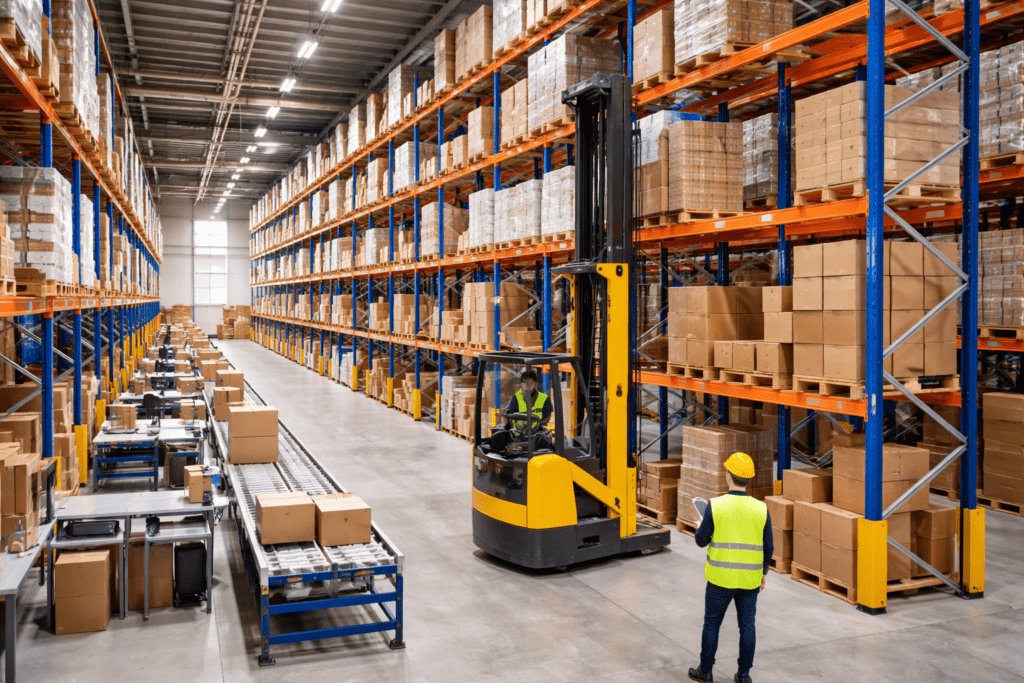
| Key Takeaways: 1. Slotting finds the best location for an SKU in a storage zone. 2. Place your top 20% of SKUs near packing stations to reduce picker travel time. 3. Analyze velocity monthly and adjust placements quarterly to maintain efficiency. 4. Reserve the golden zone (waist-to-shoulder height space) for your fastest-moving items. 5. Combine multiple slotting strategies (dynamic, ABC, and zone-based) for optimal results. 6. Use platforms like Storfox for unified data, real-time monitoring, and sustainable slotting strategies. |
On paper, your warehouse has the space. Your inventory fits. But there are issues. Picker staff is taking twice as long to find an item, there’s no place for new inventory, and fulfillment is taking a back seat.
You don’t have a space problem. You have a slotting problem.
Understanding warehouse slotting is easier if you think of a library. Just collecting and dumping all the books in one place doesn’t work. They need to be organized by category and demand, so the in-demand materials are easy to reach.
Warehouses work the same way. If the inventory is placed based on usage and movement, finding and picking an item is a piece of cake. It saves time, improves fulfillment, and increases warehouse efficiency.
This blog discusses slotting optimization, its benefits, and best practices in detail. Let’s dive in.
What Is Warehouse Slotting?
Warehouse slotting is the strategic process of determining where each product should be placed. While it seems simple, it is more than just storing the inventory in the given space.
Efficiently slotting a warehouse means organizing inventory based on data, not on guesswork or empty space. It depends on the item’s order velocity, size, weight, demand, and more.
Should fast-movers be near packing? What items are usually ordered together? How much space would a unit take? Slotting takes all of it into consideration.
Also, it’s not a one-time setup. It adapts as your inventory and order patterns change. Slotting optimization utilizes analytics and algorithms to continuously evaluate and refine product placement based on actual performance.
The goal? To reduce inefficiencies and improve fulfilment and replenishment flow.
While it’s easy to hash out a slotting plan for a small space, with a growing number of SKUs (and a larger space), you need to automate slotting. Warehouse management software can help with that (will discuss it later in the blog).
Benefits of Warehouse Slotting: Why It Matters
Just like a sorted library makes it easy to pick up a book, a well-slotted warehouse or distribution center (DC) improves your process efficiency. Here’s why it is important to slot your warehouse:
Faster Order Fulfillment
When items are where they should be, orders ship faster. Studies show properly slotted warehouses improve order preparation rate by 15-30%.
Increased Storage Capacity
Better cube utilization means storing more without expanding. Matching product dimensions to slot sizes eliminates wasted vertical space.
Fewer Picking Errors
Clear, logical item placement minimizes confusion during picking, reducing errors, returns, and re-shipments.
Improved Workplace Safety
Proper slotting places heavy or bulky items at ergonomic heights and prevents aisle congestion, lowering the risk of injuries and accidents.
Better Inventory Visibility
Organized slotting makes cycle counting easier and inventory discrepancies more obvious. You catch problems before they become stockouts.
Scalability
As your business grows, intelligent slotting grows with you. Dynamic systems adapt to new products and changing demand without complete overhauls.
Types of Slotting Strategies
Different warehouses need different slotting approaches. Here are the primary warehouse slotting strategies:
Random Slotting
Products are stored in any available location. This maximizes space utilization but increases pick time. Best for warehouses with automated systems that track exact locations.
| Pros | Cons |
| No empty slotsMaximizes space utilizationFlexible for varying inventory levels | Longer pick timesRequires advanced WMSDifficult for manual operations |
Fixed Slotting
Each SKU has a permanent home. Pickers learn locations quickly, but it wastes space when inventory levels fluctuate. Best for stable inventory with consistent demand.
| Pros | Cons |
| Pickers memorize locations easilyNo technology requiredSimple to implement | Wastes space during demand fluctuationsInflexible for seasonal changesEmpty slots common |
Dynamic Slotting
Locations change based on real-time data like velocity, seasonality, and order patterns. Requires WMS support but delivers optimal efficiency. Best for growing e-commerce operations with changing demand.
| Pros | Cons |
| Adapts to real-time demandOptimal efficiency continuouslyResponds to trends automatically | Initial setup complexityRequires WMS investmentStaff need training on changing locations |
Class-Based Slotting (ABC Slotting)
Products are grouped into classes (A: high-velocity, B: medium, C: low) and placed accordingly. A-items get prime locations near shipping. Best for most warehouses as a foundational strategy.
| Pros | Cons |
| Easy to understand and implementBalances simplicity with efficiencyWorks without advanced tech | Doesn’t consider product relationshipsMisses co-ordering patternsTreats all A-items equally |
Zone-Based Slotting
Similar products or those frequently ordered together are grouped in zones. Reduces pick paths for multi-item orders. Best for operations with strong product affinity patterns.
| Pros | Cons |
| Logical for pickersGreat for multi-item ordersReduces pick paths significantly | Requires order history analysisLess flexible for single-item ordersZone boundaries can create inefficiencies |
Most modern warehouses benefit from combining strategies. Use ABC classification as the foundation, then apply zone-based grouping within each class, all managed through dynamic adjustment capabilities.
Factors to Consider Before Determining Your Slotting Strategy
Choosing the right slotting strategy isn’t one-size-fits-all. Here’s what you need to evaluate first before deciding on a slotting technique:
Product Velocity
How fast does each SKU move? Velocity helps determine which items require priority placement and which can be stored farther from active pick areas.
Order Affinity
Which products are commonly purchased together? Strong affinity patterns influence whether zone-based or hybrid strategies will be effective.
Physical Characteristics
Product size, weight, fragility, and handling requirements impact where items can be stored safely and efficiently.
Seasonality and Trends
Winter gear shouldn’t occupy prime space in summer. Make your slotting flexible to seasonal demand cycles.
Picking Method
Are you doing discrete picking (one order at a time), batch picking (multiple orders), or wave picking (scheduled batches)? Each method has different slotting requirements.
Warehouse Layout
Your building’s physical constraints, like columns, dock locations, and ceiling height, define what slotting configurations are physically possible.
Your Pre-Slotting Data Collection Checklist
Don’t just go with any slotting strategy you like. Answer these questions before you decide on what slotting approach would be best for your business:
- What SKUs are you managing?
- What’s your inventory turnover rate by product category?
- What’s your current storage capacity versus actual space utilization?
- What ratio of reserve storage to active picking locations do you need?
- Which product combinations appear together in orders most frequently?
- Which items are currently positioned furthest from your packing stations?
- How do you measure and store items? Cases, eaches, pallets, or mixed UOMs?
- What’s your average inventory holding period before replenishment is needed?
- Do any products require special handling (climate control, hazmat compliance, or fragile item protocols)?
Collecting this data upfront prevents costly trial-and-error and helps you choose a strategy that actually fits your operation.
Best Practices in Warehouse Slotting
Implementing slotting effectively requires more than just theory. Here are proven practices that deliver results:
Apply the Pareto Principle (80/20 Rule)
Typically, 20% of your SKUs generate 80% of your orders. Identify these high-runners and give them the best location close to packing stations, in easily accessible slots. A warehouse management system can automatically track which items fall into this critical 20% based on actual order data.
Leverage the Golden Zone
The “golden zone” is the space between waist and shoulder height, the most practical picking area. Reserve this premium space for your fastest-moving items. Slow-movers can live on top or bottom shelves.
Group by Order Affinity
Use order history data to identify products frequently purchased together. Placing related items in the same zone or adjacent aisles dramatically reduces pick time for multi-item orders. Modern WMS platforms can analyze order patterns and help you plan optimal groupings.
Maximize Cube Utilization
Plan your locations in terms of cubic space. Match product dimensions to slot sizes. Storing small items in oversized locations wastes valuable vertical capacity.
Implement Forward-Pick and Reserve Locations
Keep a small quantity of fast-movers in forward pick locations for easy access, with bulk inventory in reserve storage. Set up automatic replenishment triggers so forward locations never run dry. WMS technology can coordinate this relationship, alerting staff when forward picks need replenishment.
Use Clear Labeling and Signage
Even the best slotting strategy fails if pickers can’t find items quickly. Invest in clear, consistent location labeling and visual zone markers.
Review and Adjust Regularly
Slotting isn’t set-it-and-forget-it. Product velocity changes with seasons, promotions, and market trends. Review your slotting data monthly and make adjustments quarterly at a minimum.
Consider Pick Path Logic
Organize locations so pickers move in a logical flow, left to right, front to back, rather than zigzagging across the warehouse.
How Storfox WMS Supports Slotting Optimization
Storfox is a cloud-based warehouse management system designed for e-commerce businesses and 2PL/3PL operations. While slotting strategy requires thoughtful planning, Storfox provides the operational infrastructure that makes executing and maintaining those strategies practical.
Unified Data Across Channels
Storfox integrates with 50+ platforms, including Shopify and Amazon, pulling all your orders into one system. It identifies the truly high-velocity items across all sales channels, which supplements your slotting decisions.
Real-Time Performance Monitoring
The Hero Board gives you live visibility into warehouse operations. Track which zones are congested, where pickers spend the most time, and which areas create bottlenecks. This real-time insight helps you identify when slotting adjustments are needed and measure whether changes actually improve efficiency.
Mobile Picking for Flexibility
Storfox’s mobile picker updates real-time location after reslotting or reorganizing. It saves pickers from confusion from new locations, extra transit, and wasted time, hence, improving efficiency.
End-to-End Inventory Visibility
Storfox manages your supply chain from receiving to delivery tracking. You can see exactly what’s in stock, what’s moving fast, and what’s sitting stagnant. All the information needed to make informed slotting decisions and adjust as inventory mix changes.
Operational Efficiency Beyond Slotting
While slotting optimization improves where products live, Storfox streamlines the entire fulfillment process. Orders flow seamlessly from your storefronts to pickers, packers, and shippers. Real-time carrier rate shopping ensures cost-effective shipping.
Conclusion
With warehouses, the most pressing challenge isn’t finding more space. It’s utilizing the available space intelligently. Poor slotting might not seem like a big issue at first, but it silently drains your efficiency, fulfillment time, and ultimately, your profits.
Most businesses think about expansion whenever they run into the space issue. What they usually ignore is how efficient
slotting improves their space capacity and workflows. Effective slotting gives products the right homes. Storfox ensures your team can execute picks efficiently, monitor performance continuously, and adapt quickly as your business grows. Book a demo now!