
Key Takeaways
- Goods-in is where warehouse bottlenecks most commonly begin, not at dispatch.
- Uneven inbound delivery schedules create immediate pressure at receiving areas.
- Poor goods-in processes slow picking, replenishment, and dispatch throughout the day.
- The right materials handling setup keeps receiving areas moving under pressure.
- Zip24 gives logistics teams the operational tools to manage inbound flow without disruption.
The Problem Is Not Where Most People Think It Is
Ask most warehouse managers where delays come from, and they will point straight to dispatch. It makes sense on the surface. Dispatch is where deadlines are visible. It is where missed cut-off times become real problems. Drivers are waiting, shipments are late, and the pressure is obvious.
But in many operations, the problems showing up at dispatch were created hours earlier. They started at goods-in. That is where warehouse bottlenecks quietly build and then spread outward through the entire facility.
Goods-in is the entry point. Everything depends on it moving smoothly. When it does not, the effects travel downstream, and no amount of effort at the picking or packing stage can fully recover the time lost.
Understanding How Warehouse Bottlenecks Form at Goods-In
A bottleneck forms whenever one stage of a process cannot keep pace with the demand placed on it. In a warehouse, the goods-in area is the stage more often than any other.
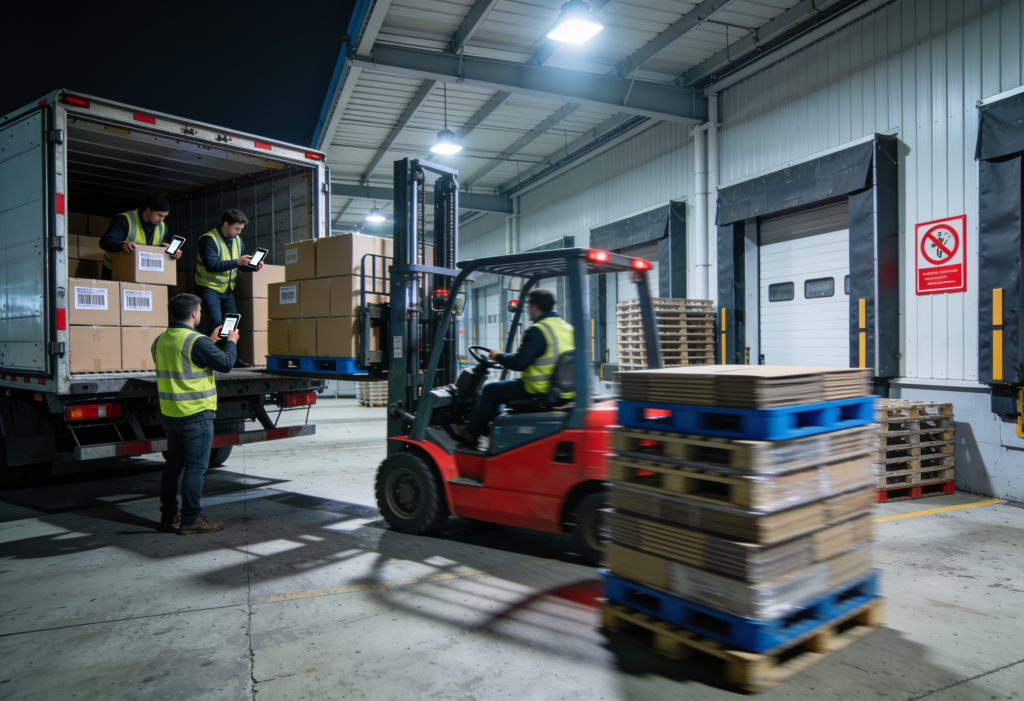
Many receiving areas were set up when supply chains ran more predictably. Vehicles arrived at reasonable intervals. Stock could be checked, counted, and moved methodically. That reliability has largely gone. Deliveries now arrive in clusters. Multiple vehicles turn up within the same short window. Then nothing comes for a couple of hours.
The result is that receiving teams face sudden bursts of pressure they were not designed to absorb. Pallets stack up in unloading bays. Temporary staging areas fill quickly. Workers spend time moving stock sideways just to create enough room to keep unloading.
The core stages of warehouse fulfilment are tightly connected:
- Receiving and unloading incoming stock,
- Checking and counting goods against purchase orders,
- Moving stock to temporary staging or directly to storage,
- Updating inventory records,
- Replenishing pick faces,
- Picking, packing, and dispatching orders.
A slowdown in the first two steps creates a knock-on effect through all the others. Warehouse bottlenecks do not stay where they start. They travel.
Uneven Inbound Flow Makes Everything Harder to Manage
Consistency is what allows a warehouse to run at capacity. When inbound deliveries arrive evenly, teams can process stock steadily, and the facility stays organized. When deliveries cluster, that steadiness disappears.
Traffic congestion, carrier routing changes, and compressed delivery windows mean that receiving areas now frequently deal with multiple vehicles arriving at the same time. The goods-in team is suddenly outnumbered by the work in front of them.
The problems that follow include:
- Pallets waiting in the unloading areas block movement for other vehicles
- Receiving teams skip thorough checking to keep pace, leading to inventory errors later
- Staging zones fill and spill into the walkways used by the rest of the warehouse
- Internal equipment, such as pallet trucks and stackers, gets tied up in receiving rather than supporting picking and replenishment
- Stock sits longer before being booked in, meaning inventory visibility suffers
At zip24, we see this pattern regularly when working with logistics operators. The goods-in area becomes a pinch point, and the rest of the warehouse spends the shift trying to catch up.
How Goods-In Congestion Affects Picking and Replenishment
Warehouse bottlenecks at goods-in do not stay in the receiving area. They spread.
Pick faces rely on timely replenishment. If new stock has not been moved from receiving to storage, replenishment cannot happen on schedule. Pickers arrive at a location to find it empty or low. They have to wait, skip the line, or escalate. Any of these adds time to the pick cycle.
In a fast-moving operation, short delays at the pick face multiply quickly. If a picker loses two minutes on each of fifty picks, that is over an hour and a half of wasted time across a single shift. Multiply that across a team, and the numbers become significant.
The knock-on effects of delayed goods-in processing include:
- Pickface shortages are causing delays mid-shift
- Replenishment teams working reactively rather than according to a plan
- Order fulfilment is slowing before orders even reach packing
- Dispatch teams are receiving fewer completed orders in time for carrier collections
- Customer deliveries are being pushed to the following day
None of this starts at dispatch. It starts at goods-in.
Why Materials Handling Equipment Matters at Goods-In
One of the practical factors that determines how quickly goods in can clear a backlog is the equipment available to move stock. When receiving areas are filled with pallets, the ability to shift stock quickly and safely becomes critical.
Operators who are working with equipment that is unreliable, undersized for the loads they are handling, or simply insufficient in quantity will always struggle during inbound pressure peaks. A single pallet truck shared between three receiving staff creates an immediate problem when four vehicles pull in at once.
The right materials handling equipment helps receiving teams:
- Move pallets out of the unloading bays quickly to free up space
- Stage stock in designated areas without blocking main thoroughfares
- Transfer goods to storage locations without unnecessary handling steps
- Keep receiving areas clear so additional vehicles can unload without waiting
Smooth movement during inbound peaks prevents the initial congestion that causes warehouse bottlenecks to form. Addressing the equipment side of goods-in is not a minor operational detail. For many warehouses, it is one of the most direct routes to better overall performance.
Why This Matters for Delivery Performance
Customers judge delivery performance on what they experience at the end. But that experience is shaped by everything that happened inside the warehouse hours before.
When goods-in runs smoothly, the downstream benefit is measurable:
- Stock reaches storage faster, and inventory records stay accurate
- Pick faces are replenished on time, and pickers work without interruption
- Orders reach packing in good time, and dispatch is not pressured
- Carrier cut-off times are met consistently
- Customers receive their deliveries when expected
When goods-in struggles, that chain breaks at the first link. Every stage after it operates under unnecessary pressure. Delivery reliability falls not because drivers are slow or routes are poorly planned, but because the warehouse never gave the process a clean start.
At Zip24, this is something we work through with clients regularly. The patterns are consistent. Warehouses that invest in their goods in operation see improvements that carry all the way through to customer satisfaction scores.
What Smarter Operators Are Doing Differently
The warehouses that handle inbound pressure well are not necessarily larger or better resourced. They are simply more organized at the point where stock enters the building.
Common approaches that make a practical difference include:
- Pre-booking inbound deliveries with designated time windows to reduce clustering
- Separating unloading bays from checking areas so vehicles do not wait while stock is processed
- Assigning dedicated receiving staff during known peak windows rather than pulling from pick teams
- Ensuring sufficient equipment is available, specifically in the receiving area, and not shared with other zones
- Using inventory systems that allow immediate goods-in booking to keep stock visibility current
- Designing staging areas with clear flow paths so that stock moves in one direction toward storage
None of these changes requires large capital investments. Most of them require rethinking how goods-in is set up and staffed, rather than buying new systems. The payoff, however, is significant because everything downstream runs better when receiving runs well.
Recognising Warehouse Bottlenecks Before They Escalate
One of the challenges with goods-in problems is that they are not always obvious until damage has already been done. A slow morning at receiving might not register as a significant issue until the afternoon shift runs behind and dispatch misses a carrier collection.
Warehouse managers who track the right indicators can catch these patterns early. Metrics worth monitoring include:
- Average time from vehicle arrival to pallet clearance from the unloading bay
- Time between receipt and stock being available in the inventory system
- Frequency of pick face shortages and their cause
- Number of orders dispatched versus orders ready for dispatch by carrier cut-off
- Equipment utilisation rates in the receiving area during peak inbound windows
When these numbers start to slip, it is usually a signal that goods in are under pressure. Addressing it at that stage is far simpler than managing a warehouse that has spent a full shift trying to recover from an early backlog.
How Zip24 Supports Better Warehouse Performance
Zip24 works with logistics operations that are serious about removing the friction points that hold performance back. Goods-in is one of the most common places we are asked to help.
The approach Zip24 takes focuses on understanding where warehouse bottlenecks are actually forming rather than treating the symptoms that show up later. If the receiving area is the source of the problem, that is where the work starts. If it is a staffing model, a layout issue, or an equipment gap, those are the things that get addressed.
Zip24 brings together operational expertise and practical logistics knowledge to help warehouses run more consistently. That means fewer delays at goods-in, fewer disruptions mid-shift, and a dispatch operation that is not constantly under pressure to make up for time lost earlier in the day.
The warehouse teams we work with find that small improvements at receiving translate into measurable gains downstream. Order completion rates improve. Carrier cut-offs are met more reliably. Customer deliveries leave on time because the process supporting them was set up properly from the beginning.
The starting point is often goods-in.
Warehouse bottlenecks rarely announce themselves clearly. They develop quietly in areas that are easy to overlook, and they create problems that surface somewhere else entirely. Dispatch pressure, late deliveries, frustrated customers, these are often the visible results of something that went wrong at the front of the warehouse many hours earlier.
Improving goods-in is one of the highest-impact changes a warehouse operation can make. It does not require rebuilding the facility or installing expensive technology. It requires understanding how stock enters the building, what slows its progress, and what needs to change to keep it moving.
If your operation is consistently under pressure at dispatch, it is worth asking whether the problem actually begins much earlier. In most cases, the answer is yes.